


[In the Media] “Making Heat Health Countermeasures a Pillar of Health Security” (The Nikkei Personal Opinion and Insight, July 1, 2026)
date : 7/3/2026
Tags: Planetary Health

![[In the Media] “Making Heat Health Countermeasures a Pillar of Health Security” (The Nikkei Personal Opinion and Insight, July 1, 2026)](https://hgpi.org/en/wp-content/uploads/sites/2/eyecatch_sugawara-3-18.png)
On July 1, 2026, an article titled “Making Heat Health Countermeasures a Pillar of Health Security” by Mr. Joji Sugawara, Vice President of Health and Global Policy Institute (HGPI), was published in The Nikkei’s Personal Opinion and Insight column.
In this article, Sugawara summarizes several key points regarding the need to position heat countermeasures at the core of health security policy:
- The Normalization of Heat Risk and the Crisis Facing Japan
In the summer of 2025, the number of people transported by emergency services due to heatstroke in Japan exceeded 100,000 for the first time since records began, marking extreme heat as an urgent risk to the lives and health of the Japanese public. The Japan Meteorological Agency’s decision in April 2026 to officially designate days reaching 40°C or above as “Extreme Heat Days” (Kokusho-bi) symbolizes the transformation of extreme temperatures into a persistent and normalized risk that society must prepare for at all times.
- International Approaches to Heat as Health Security
The United Kingdom has institutionalized a four-tier warning system coordinated between its Meteorological Office and Health Security Agency, while France has introduced measures including the prohibition of renting poorly insulated homes and mandating green infrastructure on buildings — both of which contribute to reducing urban heat risks. The international community has already recognized heat countermeasures as a practical form of health security, protecting labor productivity, healthcare systems, and social stability.
- Structural Challenges and the Need for an Integrated Response in Japan
Japan has made incremental progress in building institutional foundations, including the establishment of cooling shelters and the mandating of workplace heat countermeasures. However, significant challenges remain in addressing the social and structural vulnerabilities at the heart of the issue — such as indoor heatstroke among elderly people living alone and urban heat island effects — as well as in constructing an integrated response framework that bridges the Ministry of the Environment, the Ministry of Health, Labour and Welfare, and the Ministry of Land, Infrastructure, Transport and Tourism, in coordination with local governments. Given the inherently cross-sectoral nature of these challenges — spanning meteorology, healthcare, welfare, labor, and urban planning — fundamental solutions cannot be achieved within siloed ministerial structures, nor can they be adequately addressed within a single fiscal year. They require a sustained, long-term commitment that transcends the annual budget cycle.
In this regard, the “Health and Medical Security” agenda promoted by the Takaichi administration holds significant promise as a cross-ministerial coordinating framework — one capable of providing more concrete and actionable direction than conventional policy documents such as the Basic Policy for Economic and Fiscal Management and Reform (Honebuto) or the Growth Strategy. By explicitly positioning heat health countermeasures as a pillar of crisis management investment within this framework, it becomes possible to realize integrated cross-ministerial responses and stable multi-year investment in addressing these challenges.
Expectations for the Next Climate Change Adaptation Plan
As a concrete near-term priority, particular importance should be placed on the forthcoming revision of Japan’s Climate Change Adaptation Plan, which is expected to be approved by the Cabinet within fiscal year 2026. It is strongly hoped that the health impacts of climate change — including extreme heat — will be recognized as a shared crisis across all ministries and policy domains, firmly grounding the recognition that “health” is the foundation upon which all societal responses must be built, and that concrete adaptive directions will be substantively embedded in the revised plan. By combining proven technologies such as insulated housing with AI-driven continuous monitoring and composite risk assessment, it will be possible to minimize health disparities and their impacts on vulnerable populations.
Furthermore, strategic investment in circular economy-compatible pharmaceuticals and medical devices, as well as care-related products demanded by an increasingly aging society, represents a seedbed for economic growth and international competitiveness. Reframing climate change responses not merely as costs or burdens, but as the greatest opportunity of the 21st century to simultaneously advance health, the economy, and society, is the essential shift in perspective needed to mobilize society as a whole. The concept of “Planetary Health” — the pursuit of interconnected wellbeing spanning human biology, natural systems, the economy, politics, and society — provides the foundational axis for designing the kind of cross-sectoral, cross-organizational national strategy that this challenge demands.
Introduction of the Planetary Health Project Joint Statement
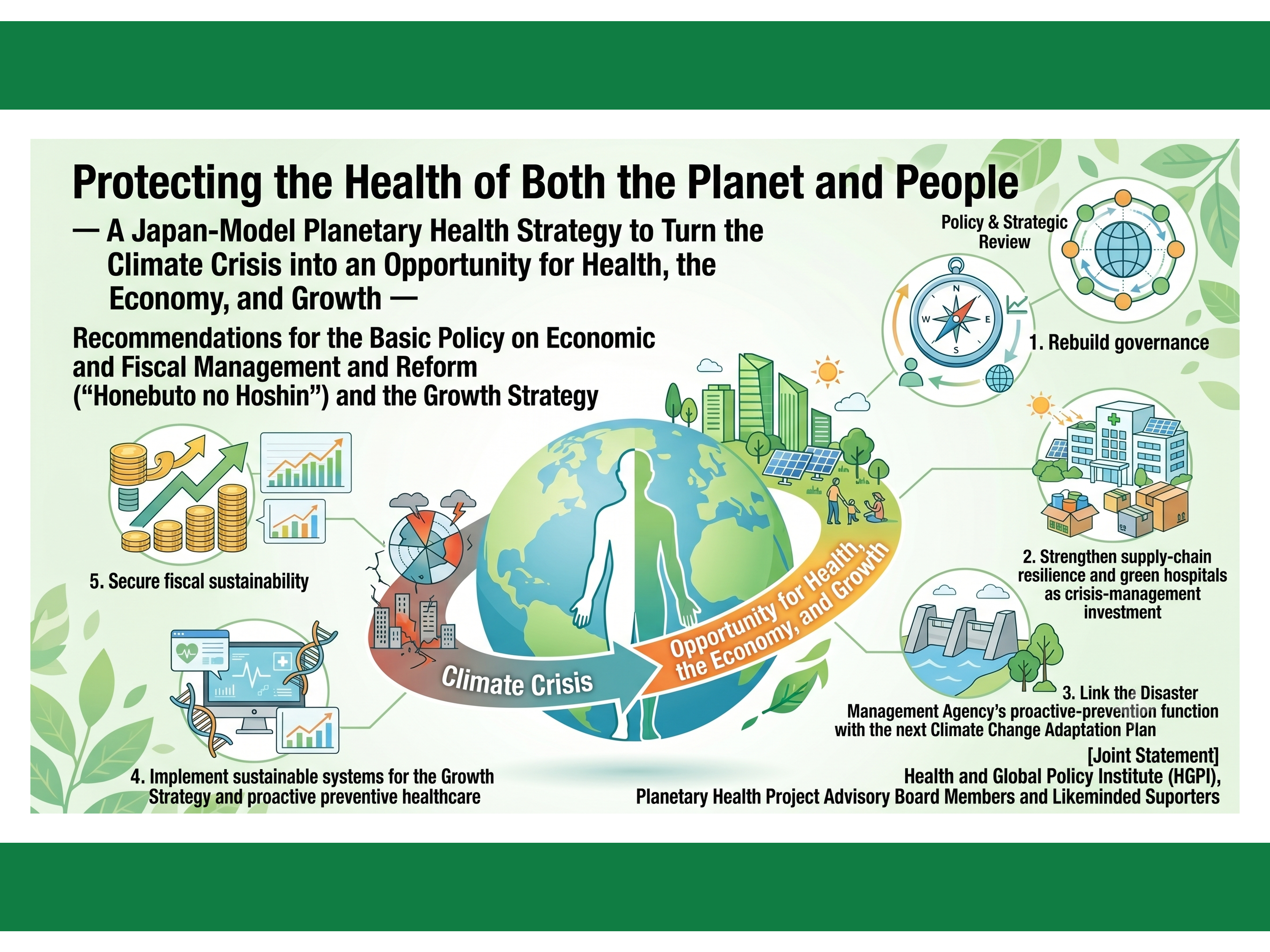
Together with the Advisory Board Members of HGPI’s Planetary Health Project, HGPI has published a joint statement titled “Protecting the Health of Both the Planet and People — A Japan-Model Planetary Health Strategy to Turn the Climate Crisis into an Opportunity for Health, the Economy, and Growth,” released on June 24, 2026. The full text of this comprehensive policy statement, encompassing recommendations on heat health countermeasures and the broader intersection of climate change and health, is available here.
The article may be found at this link. (Viewing the full article requires a Nikkei user account.) *Available only in Japanese
Related Posts
-
2026-06-24
[Policy Recommendations] Joint Statement "Protecting the Health of Both the Planet and People — A Japan-Model Planetary Health Strategy to Turn the Climate Crisis into an Opportunity for Health, the Economy, and Growth" (June 24, 2026)
-
2026-05-01
[Activity Report] HGPI Participates in Dialogue to Develop "Five Recommendations to Protect Communities from a Changing Climate" (April 9, 2026)
-
2026-04-20
[In the Media] "Final Report on the Information Collection and Confirmation Survey on Climate Change Countermeasures and Planetary Health in the Health Sector Worldwide" (JICA, January 2026)
-
2025-12-22
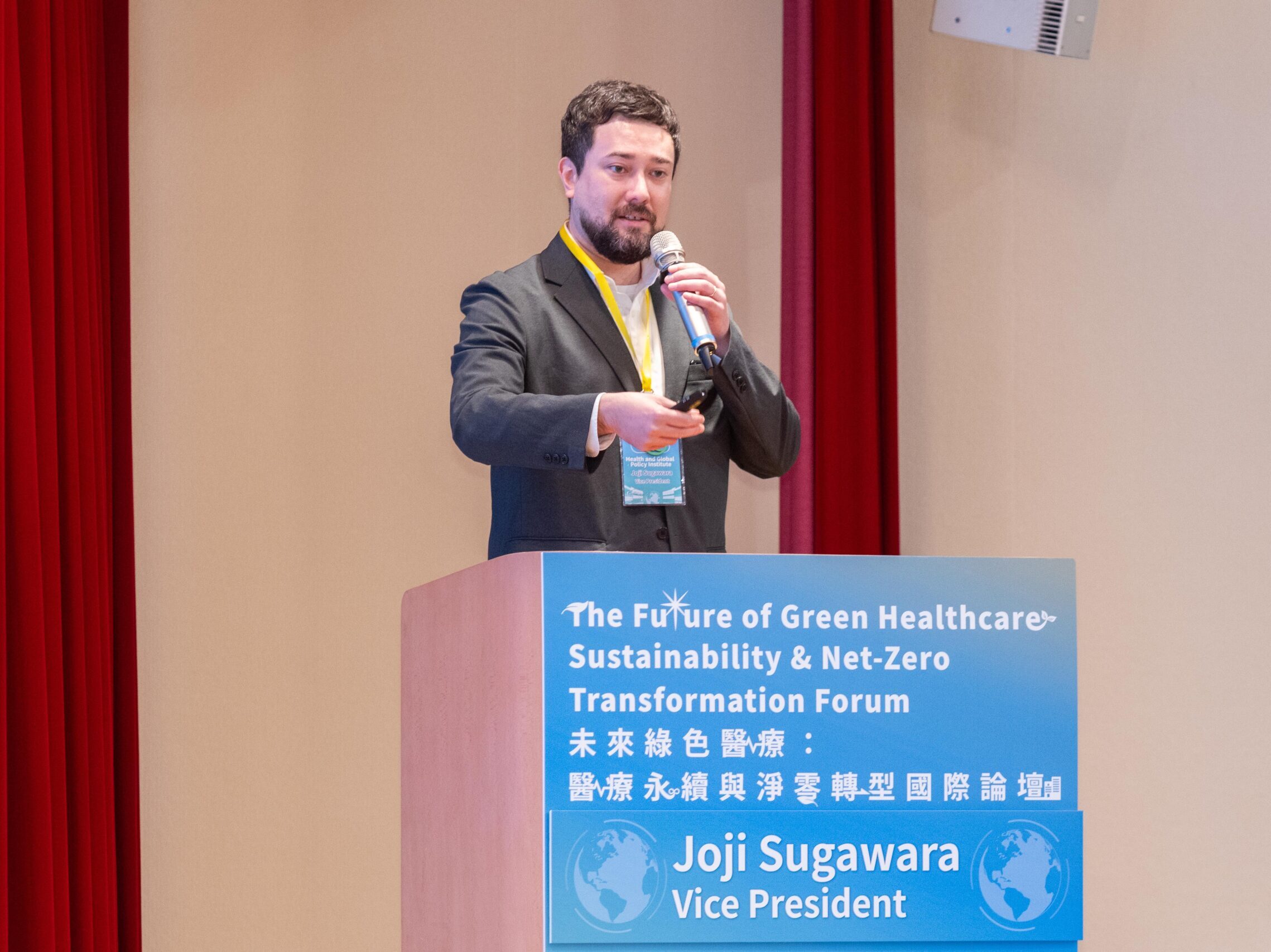
[Lecture Report] The Future of Green Healthcare: International Forum on Healthcare Sustainability and Net-Zero Transformation (Institute for Information Industry (III), November 25, 2025, Taipei, Taiwan)
-
2025-08-12
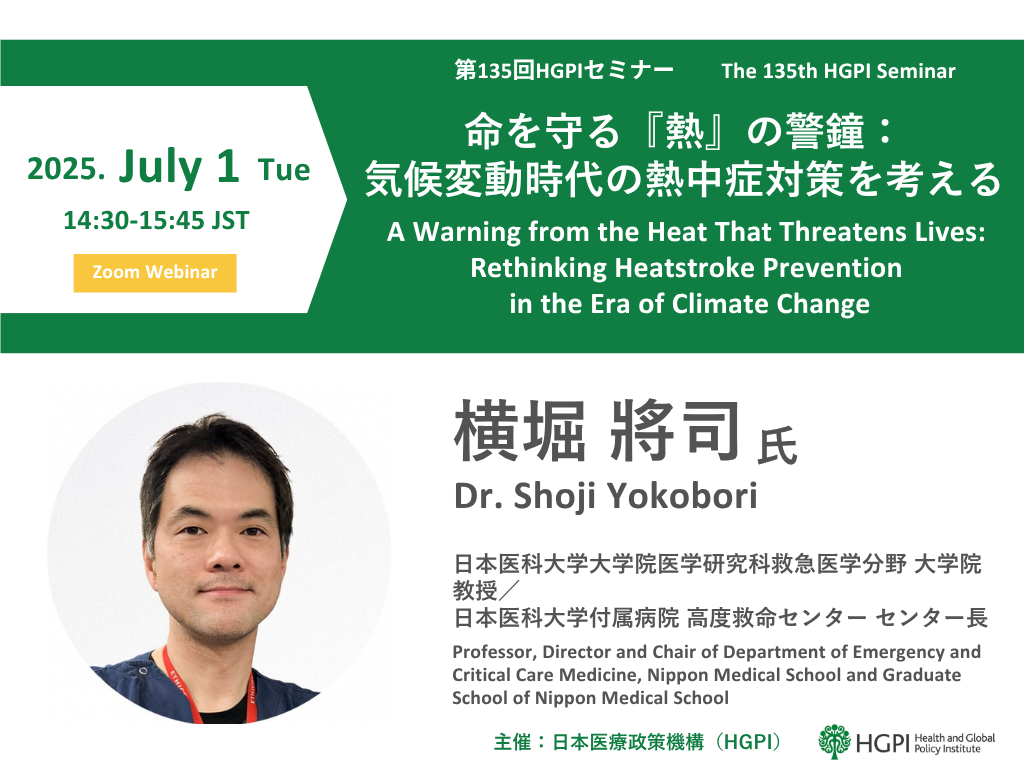
[Event Report] The 135th HGPI Seminar “A Warning from the Heat That Threatens Lives-Rethinking Heatstroke Prevention in the Era of Climate Change” (July 1, 2025)
-
2026-04-15
[HGPI Policy Column] (No.70) — From the Planetary Health Project “Part 17: The Lancet Countdown: A ‘Lifeline’ for Health and Economy Brought about by Climate Action”
Top Research & Recommendations Posts
- [Policy Recommendations] Joint Statement “Protecting the Health of Both the Planet and People — A Japan-Model Planetary Health Strategy to Turn the Climate Crisis into an Opportunity for Health, the Economy, and Growth” (June 24, 2026)
- [Policy Recommendations] Improving Patient Access to Genomic Cancer Medicine (August 10, 2023)
- [Research Report] Perceptions, Knowledge, Actions and Perspectives of Healthcare Organizations in Japan in Relation to Climate Change and Health: A Cross-Sectional Study (November 13, 2025)
- [Research Report] Energy Conservation and Greenhouse Gas Emissions Reduction in Healthcare Facilities: Case Studies from New Construction and Facility Renewal (March 16, 2026)
- [Policy Recommendations] Developing a National Health and Climate Strategy for Japan (June 26, 2024)
- [Research Report] AMR Policy Update #6: The New Global Action Plan on AMR (Part 1)
- [Recommendations] Strengthening Epidemiology Education in the Veterinary Field for the One Health Era (June 19, 2026)
- [Policy Recommendations] Reshaping Japan’s Immunization Policy for Life Course Coverage and Vaccine Equity: Challenges and Prospects for an Era of Prevention and Health Promotion (April 25, 2025)
- [Public Comment Submission] “The 7th Science, Technology and Innovation Basic Plan” (Draft) (February 19, 2026)
- [Policy Recommendations] Mental Health Project: Recommendations on Three Issues in the Area of Mental Health (July 4, 2025)
Featured Posts
-
2026-06-04
[Registration Open] (Webinar) The 3rd J-PEP Seminar “Social Participation of People with Intractable Diseases and the Potential of a New Way of Working — ‘RD Workers’ — Lessons from Policy Advocacy Practice” (July 22, 2026)
![[Registration Open] (Webinar) The 3rd J-PEP Seminar “Social Participation of People with Intractable Diseases and the Potential of a New Way of Working — ‘RD Workers’ — Lessons from Policy Advocacy Practice” (July 22, 2026)](https://hgpi.org/en/wp-content/uploads/sites/2/HGPI_20260722_The3rd-J-PEPseminar.jpg)
-
2026-06-15
[Registration Open] (Hybrid Format) Multidisciplinary Symposium for Cardiology, Nephrology, and Metabolic Medicine “Future Actions for Making Full Use of the Health Checkup System: Connecting Checkups to Treatment From the Perspective of Data Linkage” (July 6, 2026)
![[Registration Open] (Hybrid Format) Multidisciplinary Symposium for Cardiology, Nephrology, and Metabolic Medicine “Future Actions for Making Full Use of the Health Checkup System: Connecting Checkups to Treatment From the Perspective of Data Linkage” (July 6, 2026)](https://hgpi.org/en/wp-content/uploads/sites/2/cvd-ckd-ncd-20260706_r2.png)
-
2026-06-19
[Recommendations] Strengthening Epidemiology Education in the Veterinary Field for the One Health Era (June 19, 2026)
![[Recommendations] Strengthening Epidemiology Education in the Veterinary Field for the One Health Era (June 19, 2026)](https://hgpi.org/en/wp-content/uploads/sites/2/HGPI_eyecatch_20260619_AMR_Recommendations.png)
-
2026-06-24
[Policy Recommendations] Joint Statement “Protecting the Health of Both the Planet and People — A Japan-Model Planetary Health Strategy to Turn the Climate Crisis into an Opportunity for Health, the Economy, and Growth” (June 24, 2026)
-
2026-07-02
[Research Report] Medical Practitioner Interviews on the Current State and Issues for Interdepartmental Collaboration in Clinical Practice for Chronic Kidney Disease (June 30, 2026)
![[Research Report] Medical Practitioner Interviews on the Current State and Issues for Interdepartmental Collaboration in Clinical Practice for Chronic Kidney Disease (June 30, 2026)](https://hgpi.org/en/wp-content/uploads/sites/2/ckd-ncd-20260630-top_ENG.png)
